Amazon and Shopify Dominate, Brands Adapting to AI Agents, OpenAI Consumer Devices Taking Shape
Amazon and Shopify Are Now Half of U.S. E-Commerce - Marketplace Pulse
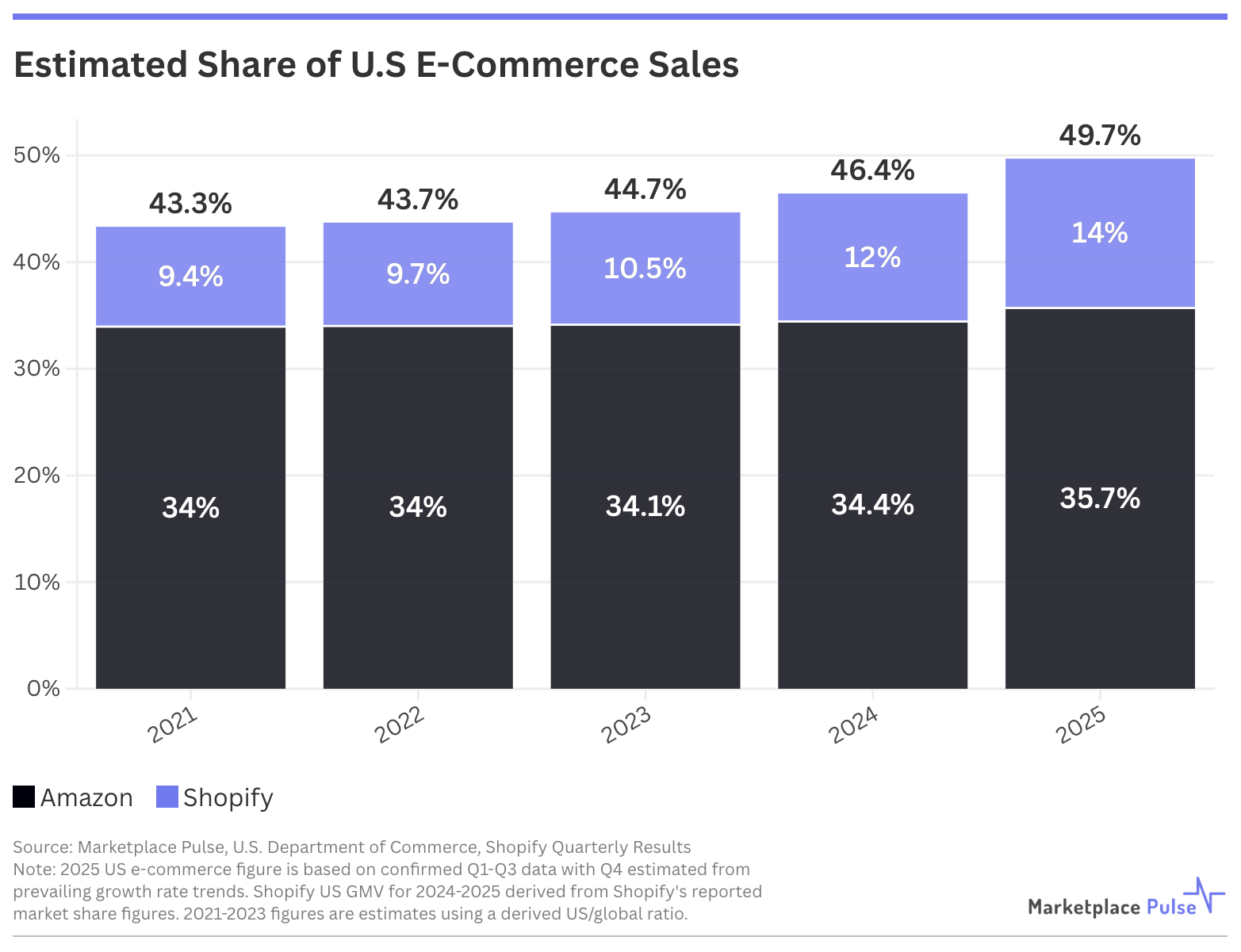
🏆 Amazon + Shopify now control ~50% of U.S. e‑commerce, with Amazon at 35.7% share and Shopify at 14%—a massive consolidation of power in two very different models.
🧩 Shopify’s shift to reporting market share signals its maturation as infrastructure, not a destination—its aggregated GMV now rivals Amazon’s 3P marketplace at 66% of its size, up from 25% in 2018.
⚔️ Everyone else fights over the remaining half, with Walmart the only scaled challenger, while eBay, TikTok Shop, Temu, Shein, and Target operate in increasingly narrow or eroding niches.
📌 Additional High‑Value Insights
The combined share grew from 43% in 2021 to nearly 50% in 2025, accelerating as the market matured.
Amazon = centralized marketplace, where shoppers interact with Amazon, not sellers vs Shopify = decentralized infrastructure, where merchants own their storefronts and customer relationships.
TikTok Shop hit $15.1B GMV in 2025, impressive but still tiny relative to Amazon/Shopify scale. Walmart’s marketplace (~$10B GMV) remains far smaller than Amazon’s but is still the most credible alternative. Temu/Shein’s de minimis advantage is eroding
How Brands Can Adapt When AI Agents Do the Shopping - Harvard Business Review
🤖 AI agents are becoming the new shopping interface, shifting discovery and purchasing from human-driven browsing to machine-driven delegation creating both speed and new trust risks for brands.
⚠️ Five trust failures threaten adoption: product misinterpretation, overstepping agent authority, mishandled conversational data, brand misrepresentation, and poor recovery when automation breaks.
🛡️ Brands must build a “trust layer” machine-readable product data, explicit delegation boundaries, visible privacy controls, agentic observability, and strong recovery paths to stay competitive as agentic commerce scales.

OpenAI Plans to Price Smart Speaker at $200 to $300, as AI Device Team Takes Shape - The Information
💰 Pricing Strategy Signals a Mass‑Market Play
OpenAI is targeting a $200–$300 price range for its first hardware device, positioning it closer to mainstream smart speakers than premium AI hardware.
This suggests a push for broad household adoption, not niche early‑adopter tech.
🧩 Hardware Team Is Rapidly Taking Shape
The company is actively building out its AI device team, indicating a serious long‑term hardware roadmap.
This aligns with OpenAI’s ambition to own the full stack—from models to consumer interfaces.
🏠 A Smart Speaker Is the First Beachhead
The initial product appears to be a smart speaker‑style device, likely optimized for natural, conversational interaction with OpenAI models.
This positions OpenAI to compete directly with Amazon Echo, Google Nest, and Apple HomePod—but with far more capable AI.